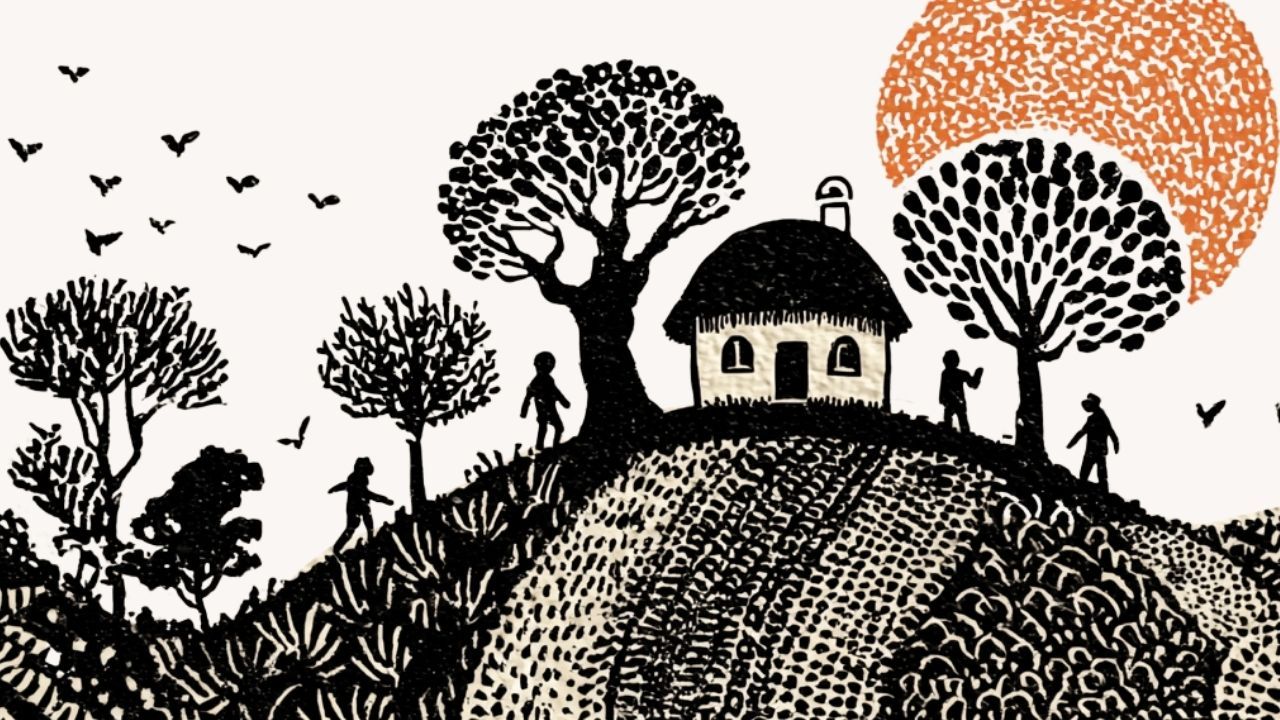
Strawbale roundhouses: portals into one-planet living
Dec 20, 2025The housing crisis isn’t just about unaffordable housing. It’s about a housing system that locks us all—wherever we are on the property ladder—into ways of being and patterns of consumption that undermine our own wellbeing and that of the living Earth.
In this post, we position straw-bale roundhouses not only as a viable solution to the problem of unaffordable housing, but as portals into a way of life more aligned with both human and ecological flourishing.
A way out?
More and more of us are looking for a path out of the destructive matrix of modernity, seeking for a way of life more aligned with human and ecological flourishing.
On that journey, housing is a key piece of the puzzle.
For not only are houses becoming increasingly unaffordable, even when we can afford one they embed us in ways of being and patterns of consumption that run counter to our own wellbeing and that of the living earth.
As part of the deeply extractive global economic system, modern housing locks us into a mesh of relations designed not to serve life—either human or more-than-human—but to generate profits.
To attempt to live well and within planetary limits while housed inside that system is like running uphill on scree. It’s impossible, and exhausting. And the slope seems only to get steeper with every new political failure or technological development.
As the years go by, we’re forced to run harder and harder just to keep still, to work longer and longer hours just to pay the bills, which leaves us less and less time or resources to shape alternative pathways.
How can we hope to change the world—or even meaningfully contribute our humble gifts to this one—if we are constantly drained by the effort just to keep a roof over our heads and to maintain some level of intentionality around our daily consumption and its impacts?
Worryingly, increasing numbers of people seem to be looking towards societal collapse as a welcome end to the strain of operating in a world that makes it impossible to align our daily lives with our deeper values.
But what if there was a way to just step off the slope onto more solid ground?
What if, instead of locking us into the destructive matrix, our homes could support us in the transition to one-planet living?
Strawbale roundhouses
One radical solution to the problem of housing is to create something new from the ground up—something that doesn’t just tinker around the edges of the issue, but instead reshapes the space of possibility.
Strawbale roundhouses represent this kind of solution.
Built mostly from readily available natural materials—straw, timber, earth, lime—and shaped in the round, these dwellings draw on long vernacular traditions while responding directly to the realities of the climate, ecological, and housing crises we face today.
They work in the UK climate, can be built quickly and affordably, and are well suited to being created in community, without specialist skills, in environments of mutual support and learning.
In these ways, and many others, they offer a fundamentally different answer to the question of shelter—one that puts solid ground beneath our feet rather than asking us to keep struggling uphill on scree.
By radically lowering the cost, complexity, and ecological impact of housing, strawbale roundhouses make it possible to step out of extractive systems and into more regenerative ways of being.
And by inviting us back into the round, they subtly reshape our relationship with the living earth, helping, in more ways than one, to restore us to the circle of life.
They offer more than a roof: they allow us to reclaim time and agency, creating the conditions for our lives to re-orient toward care, creativity, and connection.
In the sections that follow, we explore how strawbale roundhouses respond to the core failures of modern housing—and why we see them not just as alternative buildings, but as portals into one-planet living.
Affordability
One of the strongest constraints on modern life is the cost of housing. Increasingly large portions of monthly income are spent on rent or mortgage payments, while at the same time utilities bills are rising across the board.
Strawbale roundhouses address this situation directly.
The cost of building one is a fraction of the cost of a conventional house—less even than the price of most new cars! And the cost of living in one is also far smaller too.
How is that?
The majority of materials are low-cost and widely available, often sourced locally: straw bales, coppiced roundwood poles, rough-sawn timber, and lime or clay for breathable plasters.
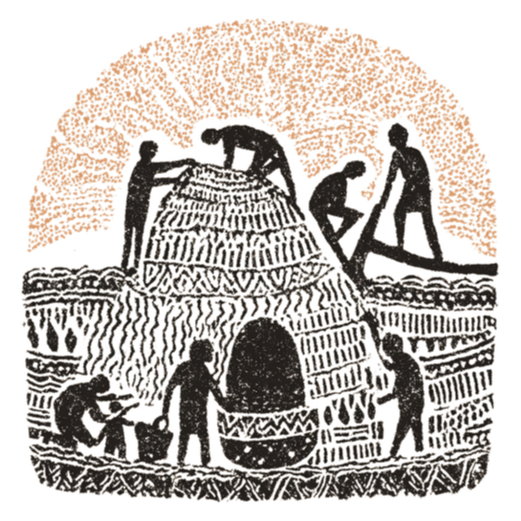
Also, because the building process is straightforward and human-scale, construction doesn't need to be outsourced to expensive specialists, meaning roundhouses are usually self-built with the help of friends and volunteers, in an environment of mutual aid and skill-sharing.
Last year, we helped a friend of the collective build a small home—kitchen/living room, one bedroom, outdoor compost loo and shower—for around £15,000. The bulk of the build happened over ten sunny days, with a group of around twelve people helping and learning. It will last at least fifty years—a hundred, if properly maintained.
A more high-spec roundhouse suitable for a small family could easily be created for around £30,000.
That’s a comfortable home for life for the same money as millions of people are currently paying for a couple of year’s rent or mortgage payments.
And the affordability does not end once the house is built.
Thick straw walls and a living green roof provide excellent insulation, keeping interiors warm through UK winters with minimal heating and cool in our increasingly hot summers without air conditioning. Super-efficient rocket stoves can handle heating, cooking, and hot water using very small amounts of fuel. Rainwater harvesting and compost loos dramatically reduce water use. All of which means significantly reduced running costs.
But there’s still more.
With low build-costs and running costs, roundhouse dwellers find themselves with plenty of time on their hands to invest in ways of living that lead to further savings: growing food, keeping animals, making and mending, and participating actively in local networks of exchange and mutual aid.
This creates a virtuous cycle in which reduced financial pressure enables a shift toward more regenerative, community-oriented ways of living—which in turn further reduces dependence on the cash economy.
Healthy interiors
Modern homes often compromise health in subtle but persistent ways. Synthetic materials, chemical finishes, poor ventilation, and poor moisture regulation can degrade indoor air quality and contribute to long-term health issues.
Strawbale roundhouses are built differently. Straw, timber, earth, and lime are all breathable, low-toxicity materials that work with moisture rather than against it. Walls finished in lime or clay plaster naturally regulate humidity, reducing the risk of condensation and mould while supporting fresh, clean indoor air.
The result is a home that feels alive rather than sealed—a place that supports the body instead of quietly stressing it.
Built for the nervous system, not against it
Beyond physical health, the form and textures of a building shape how we feel inside it. Much modern housing is dominated by straight lines, hard surfaces, and right angles—forms rarely found in nature. Research and lived experience suggest that such environments tend to create low-level stress, keeping the nervous system on alert.
Strawbale roundhouses offer a very different lived experience. Curved lines, textured surfaces, and circular layouts create a sense of natural enclosure without confinement. Sound is softened, light moves gently across walls, and there are no sharp corners and hard edges.
Many people describe these spaces as calming, womb-like, and deeply restful. This is not incidental: the circle is a form the human nervous system recognises as safe, coherent, and whole.
Low-carbon homes
The ecological footprint of conventional housing is enormous, both in construction and in use. Strawbale roundhouses offer a compelling alternative.
Straw is an agricultural by-product that stores more carbon than is emitted in its production. When used in walls, that carbon is locked away for the life of the building. Timber elements similarly store carbon, while earth and lime have far lower embodied energy than cement-based materials.
Combined with excellent thermal performance, this means strawbale roundhouses can be low-carbon—or even carbon-negative—over their lifetime, while still providing comfort suited to the UK climate.
Buildings that give back to the land
Most buildings replace living systems with dead surfaces. Living roofs reverse this logic.
A green roof takes the footprint of the building and lifts it skyward, replacing the soil and vegetation once on the ground with an equivalent covering on the roof. This maintains habitat for insects, birds, and plants while insulating the building below.
Visually, it allows the structure to sit quietly in the landscape rather than standing out into it, softening the boundary between built and natural environments.
Rather than separating people from nature, the building itself becomes part of the ecosystem it occupies.
The meaning and efficiency of the circle
The circular form is not only soothing—it is practical. A circle encloses more space with less wall than a rectangle, reducing material use and distributing structural loads evenly. This efficiency matters in one-planet living, allowing more to be done with fewer resources.
But the deeper power of the circle lies in what it expresses. Life moves in cycles: seasons, months, days, growth, decay, renewal. Living in the round subtly reorients daily life toward this core understanding, countering the sense of separation and linearity that underpins so much ecological damage.
The shape of the home itself becomes a quiet reminder that we are part of something larger, a circle within a complex pattern of nested circles—not isolated shapes standing outside the web of life.
Doorways into one-planet living
Taken together, the qualities of these structures point to something more than an alternative building method.
Strawbale roundhouses not only reduce the cost of living, lower environmental impact, and support physical and mental wellbeing, they reshape how people relate to land, resources, and each other.
They make it easier to live within planetary limits—not through sacrifice, but through better design.
They also free us up to embrace right livelihood, by reducing the need to earn high incomes simply to afford shelter, utilities, and the cost of maintaining conventional homes. Instead, we can focus our time and energy on work that feels meaningful—whether that's growing food, caring for others, creating art, or contributing to our communities in ways that nourish rather than deplete.
In this sense, the roundhouse is a portal: a way of stepping out of extractive patterns and into a mode of living that is simpler, healthier, and more connected to each other and to the living Earth.
A proven approach in the UK context
Strawbale roundhouses are not just a nice idea. Across the UK, people have been living in them for decades—through winters, storms, and everyday life.
From early pioneers to more recent low-impact developments, low-impact roundhouses have demonstrated that it is possible to live comfortably, affordably, and lightly on the land in a temperate climate.
Their success has helped shift conversations about what housing can be, and who gets to build it.
It’s time now to raise the profile of this beautiful housing solution into broader awareness, and to make it easily accessible for everyone wishing to step into one-planet living here in the UK.
Next steps
The Land-Based Living Collective exists to help make one-planet living genuinely accessible in the UK.
We're working to open clear, practical pathways back onto the land—particularly in community settings—so that more people can move out of extractive housing systems and into homes and livelihoods that support both human and ecological flourishing.
If this vision resonates, you can explore our work and get involved here:
Check out our community design →
Read more about our mission →
Explore our roadmap →
Get involved →
Join our online hub
The hub is our free collaboration space for creating land-based communities in the UK. If you're feeling the call back to the land and community, come on in and join the others who feel the same. Together, we can forge a path.
Insights in your inbox
Subscribe to receive new posts the moment we publish them.