From empty fields to one-planet communities
Dec 07, 2025Almost any field in the UK could be transformed into a permaculture wonderland of low-impact living, biodiversity, and regenerative agriculture.
On 40-50 acres, it’s possible to create a land-based community of 15 households, produce abundant food through small-scale diversified farming, and nurture a thriving mosaic of habitats supporting as much nature recovery as a long-term re-wilding site.
In this post, we'll explore why this integrated approach makes so much sense, and how we can start creating these settlements across the UK.
It's time to repopulate the countryside
The British countryside is a pale shadow of what it once was.
Industrial farming, narrow conservation strategies, and aggressive urbanisation have left our landscapes deeply impoverished—in ecological, agricultural, and human terms.
Many are turning to re-wilding as an answer. But while re-wilding can certainly help restore ecological abundance, it does little to address the rising spectre of food insecurity or our disconnection from the land and each other.
A far better option in many cases would be to reintroduce humans back into the countryside as a beneficial keystone species, in settlements designed to provide genuinely affordable low-impact housing, meaningful land-based livelihoods, and lovingly grown food, all while actively supporting nature recovery.
One-planet communities: a solution multiplier
More and more of us are aware that we live in a world of multiplying crises: ecological, climate, housing, cost of living, mental and physical health, social isolation, and the relentless erosion of our sense of belonging and meaning.
But far fewer people realise that there's a way of life that responds directly to all of these issues at once—not through grand policy interventions or shiny new technologies, but through the simple, quietly revolutionary act of coming home to the living earth and to each other.
That way of life is land-based community living.
The startling fact is, a single 40–50 acre field almost anywhere in the UK can house a low-cost land-based community of 15 low-impact households while at the same time producing as much—or more—food as it did previously and becoming a thriving mosaic of habitats that supports as much biodiversity recovery as a long-term re-wilding site.
That's affordable homes, land-based livelihoods, nutrient-rich food, community, and nature recovery all on the exact same piece of monoculture land currently used only for chemically grown crops.
Surely it's time to start embracing this opportunity?
From fragmented to integrated land-use systems
The dominant model of land-use in the UK is deeply fragmented. It separates housing from farming, and both from the care of wild nature. Each sector operates in isolation, with separate goals, separate funding, and often at cross-purposes.
But what if we could integrate them? What if the same piece of land could support affordable, low-impact homes, regenerative food systems, and thriving ecosystems—all at once?
As we've seen, the one-planet community model does just that.
In this model, natural homes nestle gently into productive landscapes rich in ecological niches, while the people who live in these homes participate fully in the life of the land, creating lives and livelihoods based on natural abundance and place-based relationships.
In this way we bring housing, food production, and nature restoration together in ways that reinforce rather than conflict with one another—while at the same time combining to create a whole raft of second and third order benefits.
Let's say it again: Affordable homes, meaningful work, low-carbon lifestyles, high-quality food, active living, supportive community, and nature recovery, all woven together into one beautiful whole. What's not to love about that?
Humans as a keystone species
Of course, this approach assumes that the presence of humans in a landscape can actively enhance rather than diminish its health, beauty and productive capacity.
Happily, this assumption is borne out by Indigenous peoples worldwide, as well as by a growing body of research into regenerative land management practices that show biodiversity and productivity increasing hand in hand when humans engage with ecosystems in thoughtful, reciprocal ways.
In one-planet communities, humans become active participants in ecosystem flourishing—coppicing woodland to create habitat mosaics, grazing animals to maintain species-rich grasslands, actively designing a wide variety of ecological niches amidst productive zones, and creating the kind of benign disturbance that many native species actually depend upon.
Rather than stepping back from the land in order to ‘conserve’ it, we step back into our role as active stewards and creative collaborators with the more-than-human world, and in so doing we rekindle our felt sense of belonging to the wider web of life.
From theory to practice
Our vision in brief:
- Transform a 40–50 acre monoculture field into a diverse mosaic of productive zones and ecological niches: vegetable gardens, food forests, ponds, orchards, wildflower margins, young woodland, mixed grazing, restored hedgerows, meadows, and micro‑field systems.
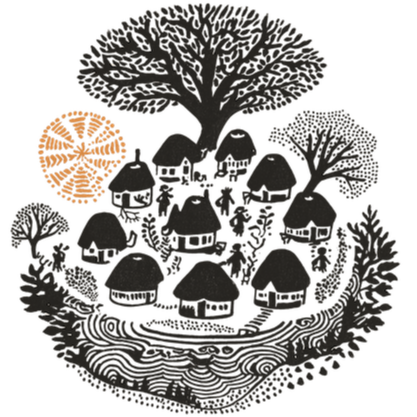
- Amongst it all, create 15 low-cost natural homes set amidst low-impact communal infrastructure and shared facilities, all of which blend harmoniously into the landscape with structures having soft rounded edges and green living roofs.
- Populate the site with people who want to live lightly, work with their hands, and belong to a collaborative community—growing food, tending land, and building a culture of connection, care, and natural abundance.
- Replicate on hundreds and then thousands of sites across the UK.
None of this is new
What we’re describing here isn’t anything new. Indigenous peoples all over the world have lived a version of this way of life for many thousands of years. Even here in the UK, rural life has until relatively recently looked much more like this than most of us now realise.
All that we’re proposing is a return to a way of life that we already know works, and incorporating a few modern innovations to create something even more resilient and abundant.
But we’re not suggesting everyone in the country should live this way.
We're only saying that those who feel called to this way of life should have the opportunity to choose it, and that our society should recognise the multiple benefits these communities provide—not just to their residents, but to the wider ecological and cultural landscape.
Why doesn’t it already exist?
If this way of living is so clearly beneficial, why isn't it already happening here in the UK?
The answer lies partly in a lack of imagination and in the absence of working models demonstrating the viability of one-planet living.
But more darkly, it lies in our country’s long history of oppression of land‑based people by ruling elites. Sadly, that history has shaped a policy environment which today systematically prevents us from living on and from the land in ways that would allow us to meet our basic needs outside of a consumer economy designed to funnel wealth and power upwards to the few at the expense of the many.
This culture of oppression, separation and exploitation has been in place for so long here in the UK that it is woven into the deepest fabric of our national life. It conditions the space of possibility to such a great degree that it makes the return to the land almost impossible.
But the more the multiple interconnected crises escalate, and the more obvious it becomes that the solutions to so many of those crises are to be found in the land beneath our feet and in our own capable hands, the harder it will become to maintain the systemic framework of separation from the land.
Let the thrutopias proliferate
The good news is that we don't need to wait for the whole system to change before we begin returning to the land and community.
Projects all over the UK are already showing us what's possible: from Lammas in Wales to Tinkers Bubble in Somerset, from community land trusts to worker cooperatives farming regeneratively.
What we need now is to make it easier for many more such projects to emerge.
To do this, we need to do two things:
- Develop an integrated model for land-based community living based on best practices established by both indigenous peoples and modern practitioners across a range of domains from natural building and agroecology to energy and community governance.
- Shift from isolated experiments to a coordinated approach with robust organisational backing.
If we can put these two things in place, land-based communities could start to spread across the country—slowly at first, and then rapidly.
Each successful new community would become a living proof of concept, making it easier for the next one to emerge and gradually building the cultural and political momentum needed to shift the policy environment towards one that enables rather than blocks these kinds of developments.
Our mission
The Land-Based Living Collective is working on this exact mission. We aim to create a vibrant network of land-based communities all across the country, for everyone who wants to adopt this way of life.
We’ve developed a community design that brings together all the practical, financial, and social elements of land-based community living—from infrastructure and land-management to governance and economic models.
While our strategic roadmap lays out a detailed pathway for building an organisational structure capable of supporting the emergence of communities across the UK.
We're now calling in people who resonate with our mission—those who want to be part of creating these communities, whether as future residents, supporters, collaborators, or advocates.
If this speaks to you, we'd love you to join us on this journey.
The bigger picture
If our global civilisation has any chance of navigating the phase shift into a more ecologically balanced and socially just future, it will require examples of viable alternatives to the industrialised monoculture that increasingly dominates our landscapes and our cultural imaginations.
Ahead of macro-level shifts we need micro-shifts, working models that demonstrate that another kind of world is not only possible, it’s achievable.
The kind of land-based communities we’re proposing could be such models.
Their proliferation could feed the imagination and show not only that it’s possible to heal our separation from the land and from each other, but that doing so can create lives of genuine richness, purpose, and belonging—lives that feel more human, more connected, and more alive than anything the consumer economy could ever offer.
Next steps
If you'd like to dig deeper into the kinds of settlements we're proposing, why we're think they're so cool, and how we plan to create them, follow the links below. And if you want to be part of the movement we're building, there are many ways to get involved.
Check out our community design →
Read more about our mission →
Explore our roadmap →
Get involved →
Join our online hub
The hub is our free collaboration space for creating land-based communities in the UK. If you're feeling the call back to the land and community, come on in and join the others who feel the same. Together, we can forge a path.
Insights in your inbox
Subscribe to receive new posts the moment we publish them.