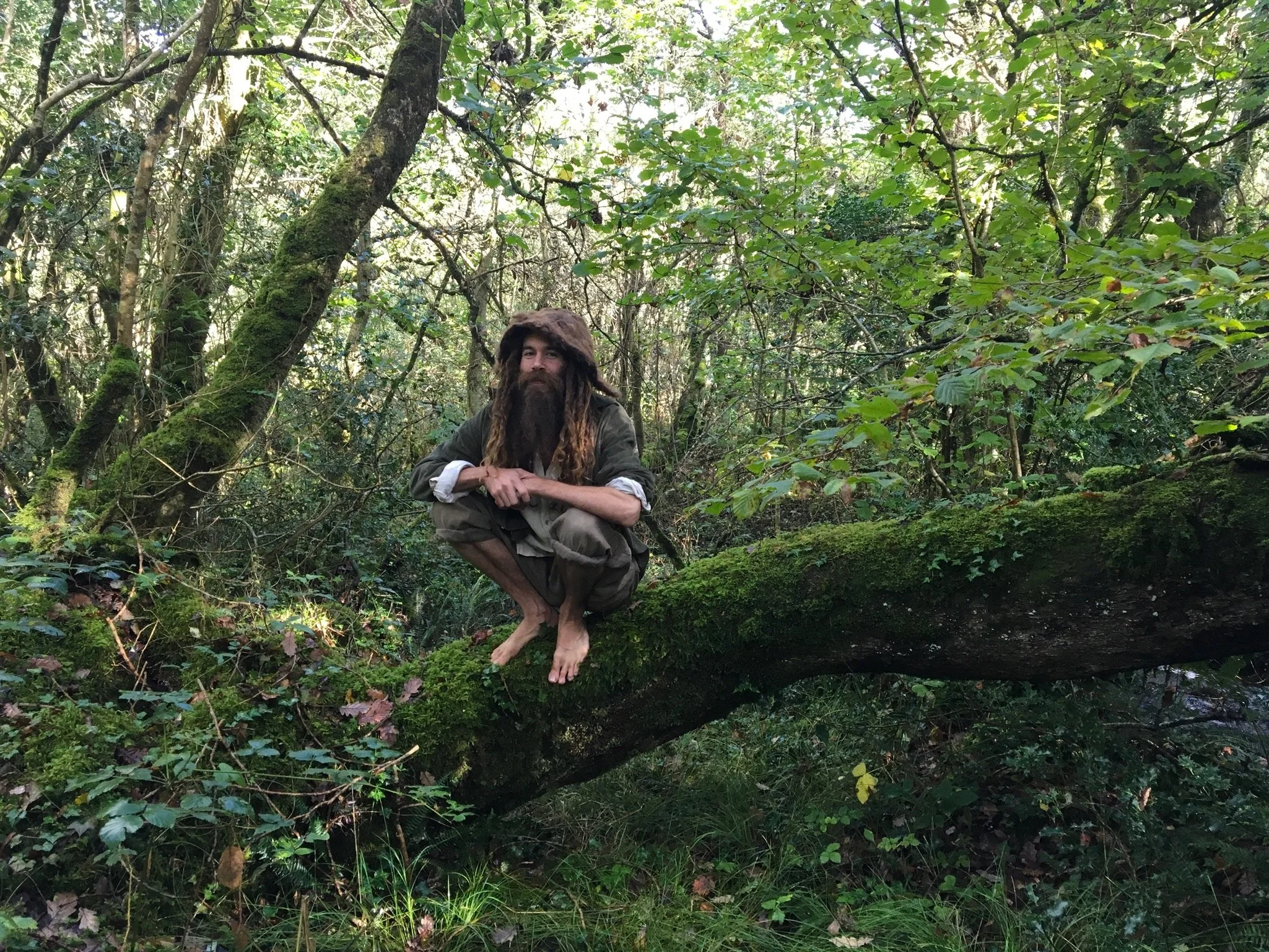
Maybe I went a little too feral?
Like you, I was born into a world in the tight grip of an economic system engineered to separate us from the land, each other, and from the living roots of joy, abundance, and meaning.
And perhaps like you too, I refused to resign myself to that world.
What follows is the story of my quest to extricate myself from industrial modernity, restore myself to the circle of life, and then find a way to help others do the same.
Early questions
Even as a young man, I felt that there was something deeply wrong with the world I was growing up in.
I experienced the symptoms acutely: the hollowness of consumer culture, the ugliness of the built environment, and the sense that modern life was organised around goals that were not aimed at serving life’s continued flourishing and could never truly satisfy the human heart.
And beneath all this sat a persistent intuition that a far more beautiful world was possible.
It was a painful juxtaposition.
At first I sought escape from this pain through drugs. Then through intense yoga and meditation. Then I found books.
Awakening to the world of thought, I read philosophy, history, religion, literature, evolutionary theory—anything that might shed light on the tragedy I was seeing and feeling all around me.
Gradually, more definite questions began to take shape in my mind: questions around the origins of social injustice and systemic violence, the real nature of progress, and ultimately the authentic place of human beings in the great dance of life and cosmos.
But very little seemed to address these questions in a really satisfying way.
The more I grappled with the seemingly irreconcilable conflicts and contradictions of the Western intellectual tradition, the more I came to see that this entire tradition occupies the conceptual space created by a false separation between mind/spirit and body/earth. Within that space, genuine answers and solutions seemed impossible.
Then I discovered Ursula Le Guin’s translation of the Tao Te Ching, and it felt like coming home.
The taoist sages were themselves responding to a cultural movement that had privileged intellectual abstractions over the real and textured ground of embodied existence, and their concern was to restore human life and the wider social order into closer relationship with the flow and patterning of natural living systems.
This resonated with me deeply, and propelled me into a quest that would take over a decade to unfold.
Touching the ground
Above all, I knew I needed contact with the land. So I moved onto a permaculture smallholding in the hills of West Wales and began the process of forming a relationship with the living earth.
It was a rude awakening, exchanging my suburban intellectual life for the practical realities of land-based living—but it was one I welcomed as fully as I could.
Working with soil, plants, and animals, wood and stone, in a context that included weather, seasons, and the daily rhythms of light and dark, brought me into sustained contact for the first time with the textured ground I sought. The work was often hard, and sometime monotonous, but I gradually eased into it and felt it strengthening me in my body and in my relationship with life.
At the same time, I started to find a useful intellectual context in works of deep ecology, eco-psychology, nature writing, and the deepening critique of industrial civilisation.
At this point, enquiry and practice started to come together, each informing the other. And the deeper I went with each, the more I saw how much deeper there was to go.
Critiques of the Western identity construct, built on alienation from the living earth, resonated deeply. I recognised their truth in my own lived experience, and came to feel that dismantling that construct in myself was the necessary first step to being of real use in the world.
It wasn’t enough to respond to the symptoms from a place that merely recognised the cause—surely one needed to get down beneath the cause itself, and then respond from that new ground.
So I wanted to follow the journey of reconnection as far as I could. And I could feel that there were layers of intimacy with the land that I was never going to reach on the smallholding.
I yearned to immerse myself in the more-than-human-world, to apprentice myself to the rhythms and animate intelligence of the living earth, to liberate myself as much as possible from the cultural paradigm that I knew to be crushing the life out the land and land-based peoples everywhere.
Descent
Following this yearning took me further than I could have imagined.
I’d been hearing about Tir Ysbrydol for a while, and eventually made it over to meet it’s guardian, Emerald.
“I’ve come to realise that I’m a conscientious objector to almost everything going on in the modern world,” she told me the first time we met. “So I moved down here to live differently, to re-integrate my life as much as I possibly can into harmonious relationship with the Earth.”
Emerald lives in a little mud hut without any kind of modern amenities, on about sixty acres of land that she calls Tir Ysbrydol and which she holds as a healing sanctuary for both nature and humans—a sacred re-wilding project for land and spirit.
Needless to say, as soon as I met her and experienced her way of life I knew I’d found exactly what I’d been looking for—a doorway deep into the land.
So I asked if I could join in, and moved to Tir Ysbrydol soon after.
There I spent the next five years immersed in a life of radical elemental simplicity, in a loose community of other humans on a path of steep descent into the ecological self.
I built a wild little mud hut deep in the jungly woods between two mossy streams. I cut wood, carried water, washed in the river, cooked on fire, sat in the starlight and learned to feel the earth turning through space. I entangled my life with the seasons, the weather, the rhythms of darkness and light.
It was often uncomfortable–muddy, damp, cold, slow, smoky, inconvenient. Life was absolutely full of the kind of elemental texture that civilisation has spent thousands of years smoothing out of our life.
But despite that, and in many ways as a consequence of it, there were frequent moments of simple wonder arising from repeated and relentless contact with the natural world—a sudden brightening of birdsong startling me into sudden panoramic awareness while chopping firewood; moonlight falling through the bare canopy and glittering on the frosted spikes of holly leaves like stars fallen to the woodland floor as I went out for a pee on a freezing winter night; or the curious haunting music made by the stream after a particularly heavy rainfall, which I could hear through the blanket-door of my little hut.
These kinds of experiences and countless others like them became endless sources of joy and wealth, made possible by the simple gesture of holding myself in direct relationship with the land.
Emerald was an amazing mentor in all this, having lived deep into these encounters herself for decades. And the community of other woodland dwellers living at Tir Ysbrydol were a lovely source of support, sharing experiences, tips, hands-on help, and a circle of wise companionship.
And beyond this human community, as my entanglement with the land progressively deepened, I felt a growing sense of fellowship with the host of wild intelligences that made up the community of life in the woods—and then deeper still, with the more primordial intelligence of the living Earth itself.
Later in my years there, I entered extended periods of exquisite beauty when the boundary line between me and the rest of life faded to almost nothing, and I moved through the land as an inseparable part of it and of the wider flows of cosmos.
In these ways, my time at Tir Ysbrydol gradually dissolved and eroded the separate self that had been constructed in me by the modern world. Not entirely, and certainly not permanently, but enough to leave a lasting trace of that deeper experience of belonging.
As such, it was far more like a prolonged initiatory experience than a retreat into the nature’s loving embrace—a five-year vision quest that slowly and sometimes excruciatingly reshaped me into someone who could genuinely call the Earth their home.
Eventually though, unexpectedly, I started to feel the stirring of departure. There was a sense that the land had worked on me enough for now, and that I had things to do out in the wider world.
Wandering
I left Tir Ysbrydol carrying gifts I did not yet know how to give.
Partly this was because I completely underestimated how difficult re-entry into modern life would be.
Years of immersion in a beautiful natural environment—one held sacred and treated with all the care of a beloved—had profoundly sensitised me. Returning to the careless violence and broken assumptions of modern life was an assault on my entire system that left me reeling.
For several years I wandered, uprooted, disoriented, confused, and often despairing.
I visited land-based projects across Britain—low-impact settlements, smallholdings, community gardens, woodland enterprises, rewilding initiatives.
I learned new skills, listened, observed, participated, and reflected.
Most of what I saw was struggling in some way, either socially, financially, or in terms of a coherent vision. And everywhere was negotiating some form of uncomfortable compromise with the wider system, which seemed to prevent anyone involved from genuinely thriving.
All the time, deep down, I just couldn’t understand why there weren’t more places like Tir Ysbrydol, and why more people weren’t throwing everything they had at exiting modernity and making a firm stand on the land.
Everywhere I went I saw the same story, the same patterns repeating—economic constraints, planning regulations, social pressures, and a total absence of systemic support for truly alternative forms of living.
I realised how lucky I’d been to have dropped like a small pebble straight through a net that most people and projects seeking a way out of mainstream life were getting caught and held in to some extent or another.
In this way, I became increasingly interested in the systemic and cultural forces that made it so difficult for most people actively trying to step out of ‘business-as-usual’ to actually do so.
What had once appeared to me primarily as a personal journey increasingly revealed itself as a much broader enquiry.
My attention widened, and I sought new perspectives.
Integration
The enquiry had ceased to be simply about how we might live differently, in ways that can restore us to the land, to each other, and to ourselves.
This question is actually already being answered quite fully, by a beautiful network of people and projects working across a wide range of domains—from agro-ecology to low-impact building to trauma-informed relating to non-hierarchal governance practices.
Instead, the enquiry shifted towards how we can bring these often fragmented domains together into robust models of alternative living, and to make these models available to as many people as possible.
The fact is, large numbers of people in Britain today long for a closer relationship with land, community, and ecological reality. Given the chance, i believe that there are tens of thousands who would leap at the opportunity to live in low-impact agro-ecological communities.
And yet, despite nationally declared climate and diversity crises, as well as the other intersecting crises which seem to press in on us more and more each week, remarkably few viable pathways currently exist for making the transition into alternative ways of living.
The central question remained: how might we create the conditions for lives rooted in belonging rather than separation? But the more deeply I explored that question in the context of post-covid Britain, the more it became an exploration of the systems that organise modern life and shape our collective possibilities.
At this point I realised that a big part of what was missing was collective agency. The emerging land-based living movement in Britain is currently still quite fragmented, full of isolated projects and groups struggling on their own in a fairly hostile economic and cultural environment.
This fragmentation can make the movement appear much smaller than it is. It also means that new groups and projects are often missing out on accumulated learnings, having to reinvent the wheel or stumbling over obstacles that could have been removed by those who have walked ahead of them.
Most crucially, from my perspective, it means that the whole field of knowledge, skills, solutions, and approaches to the basic question of how to live well on a finite planet are remaining scattered, failing to integrate into the holistic models of one-planet living that can be far greater than the sum of their parts.
This central insight led me to found the Land-Based Living Collective.
I wanted this to be an enabling organisation that could unite and channel enough collective agency from across the land-based movement in Britain to create a network of one-planet communities—sanctuaries a little like Tir Ysbrydol but embracing a wider range of low-impact solutions: renewable energy, comfortable and beautiful low-impact homes, appropriate technology, progressive governance, and a whole field of other highly developed approaches to living well together on the land.
But sadly, after trying for nearly 3 years to get this organisation off the ground and not really getting anywhere, I ran out of steam and had to let go of the attempt.
Clarity
While difficult, that failure has also proved clarifying.
I’ve come to recognise that my strengths don’t lie in organising and implementing. I tried, but that’s just not who I am.
Accepting this, I’ve adjusted my approach, and this site represents the new direction I’ve arrived at.
For now, my role feels simple:
To live small and think big.
To write, to inspire, to propose and to provoke.
To articulate possibilities that are currently hidden at the margins, and to help draw attention to the wider systemic patterns and forces working hard to keep them there.
To document what is emerging, and to help make more visible the vibrant eco-system of amazing projects that could one day soon coalesce into an organised and powerful movement towards a one-planet future.
The longing that first set me on this path remains alive. So too does the conviction that more beautiful ways of living are possible.
And this conviction is no longer coming from a vague intuition, as it was at the start of my journey, but from longstanding enquiry, from witnessing first-hand the work of so many wonderful people all over Britain, and from deeply lived experience.
In one way or another—whether through wise choice or through the collapse of the matrix of separation—the future is land-based. And yes, that future can be incredibly beautiful.
I for one am going to do all I can to help bring it about as rapidly and gracefully as humanly possible.
A note on what's not here: this is the story of my life as it pertains to the work I'm now doing—the trajectory, not the whole terrain. Much has been left out, including people who matter enormously to me. I have a son, for instance, who isn't part of this account. There's something uncomfortable about that omission in particular, as well as others—but there's only so much life story a short narrative can carry.
I don’t tell this story to inspire others to follow a similar path. I actually believe that there are more direct routes than the one I took to the place I really wanted to reach.
While I hold my years in the woods as among the most precious of my life, the most meaningful part of my journey so far has become the work of translating their gifts into forms that are more generous, more relational, more convivial, and more deeply integrated into wider society.
How might a deep experience of belonging to the living earth emerge within intergenerational communities of solidarity and care, and from there become part of a deeper cultural renewal?
This is the question that shapes my current work and thinking.